
Processes - Briefs
Content (SEO) Briefs
Writing a good
SEO brief...
Write for the User
Prioritise the reader's needs, not search engines. The goal is to answer their questions clearly and comprehensively. Optimisation comes naturally when content is genuinely useful.
Make the Brief Clear
Explain what the copywriter should cover. Provide headings, subheadings, tone guidance, and internal link suggestions so there's no guesswork.
Include Targeted Keywords
Identify the main keyword, synonyms, secondary terms, and FAQs. This helps guide the content towards ranking opportunities and ensures topical depth.
Think About the Format
Define how the content should be presented:
- Format: Written text, bullet list, table, or something else?
- Supporting data: Include internal or third-party stats if needed.
- Assets: Would a video, visual guide, or tool strengthen the section?
- References: Link to reputable sources (e.g. government sites) where appropriate.

We have two types of content brief depending on the geographic scope of the work. See below for when to use each.
Brief templates can be created from within your client folder by right clicking and selecting a brief from any of our Google doc templates.
Create from template instructionsSingle Market
Content Brief
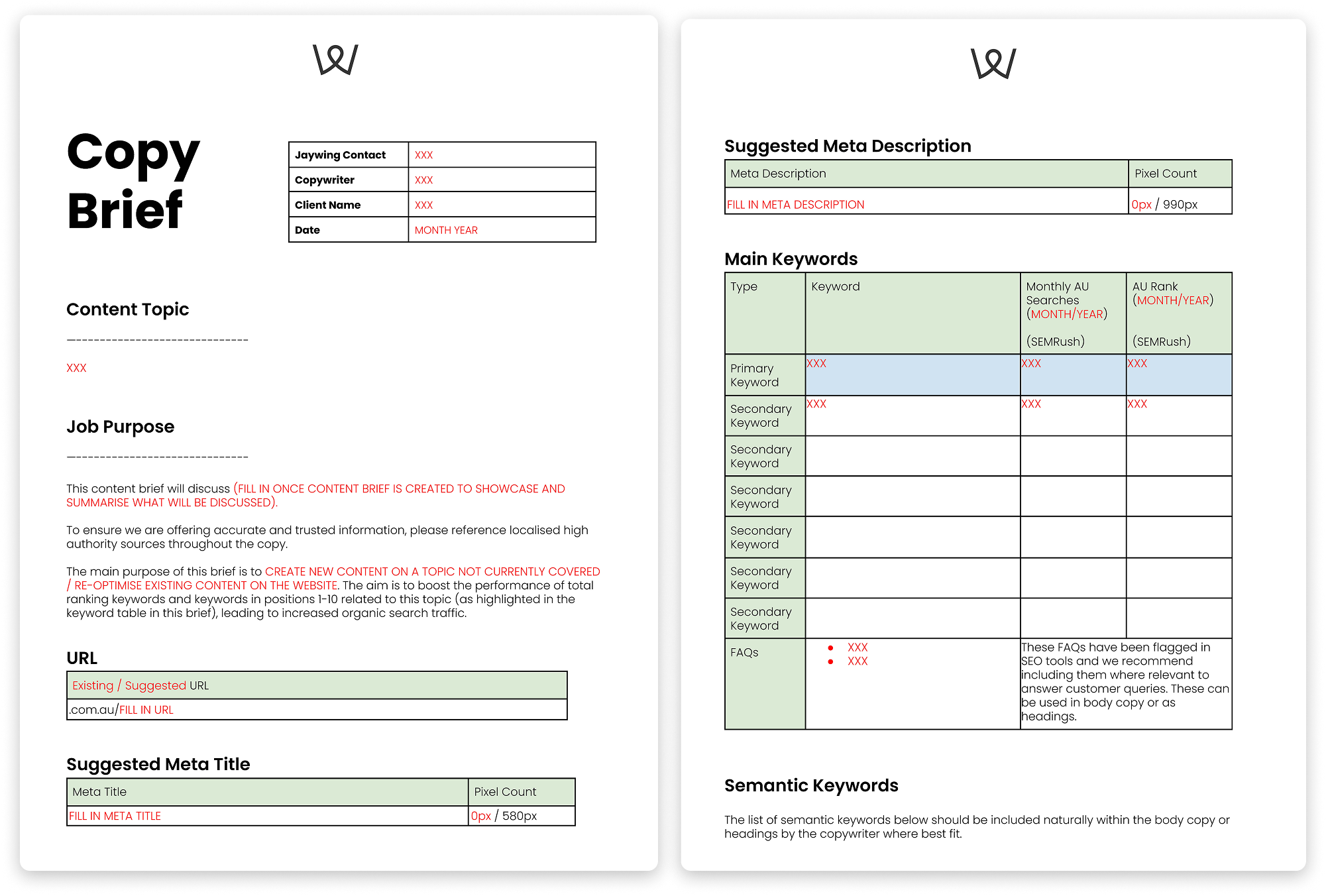
A content brief for a single market gives a copywriter or content creator clear direction on how to write for one specific geographic or audience market. For example, this could be for Australia, Singapore, or the Philippines.
What to populate:
- Content Topic + Job Purpose: Summarise what the content will discuss. State whether the goal is to create new content on a topic not currently covered, or to re-optimise existing content.
- URL + Meta Data: Provide the existing or suggested URL. Complete the meta title (580px max) and meta description (990px max). Pixel count fields track character length automatically.
- Main Keywords: Include one primary keyword and up to six secondary keywords. Pull monthly search volume and current AU rank from SEMRush. Add FAQs flagged by SEO tools for the copywriter to address naturally.
- Semantic Keywords: List semantic keywords the copywriter should weave naturally into the body copy or headings to support topical authority.
Multi Market
Content Brief
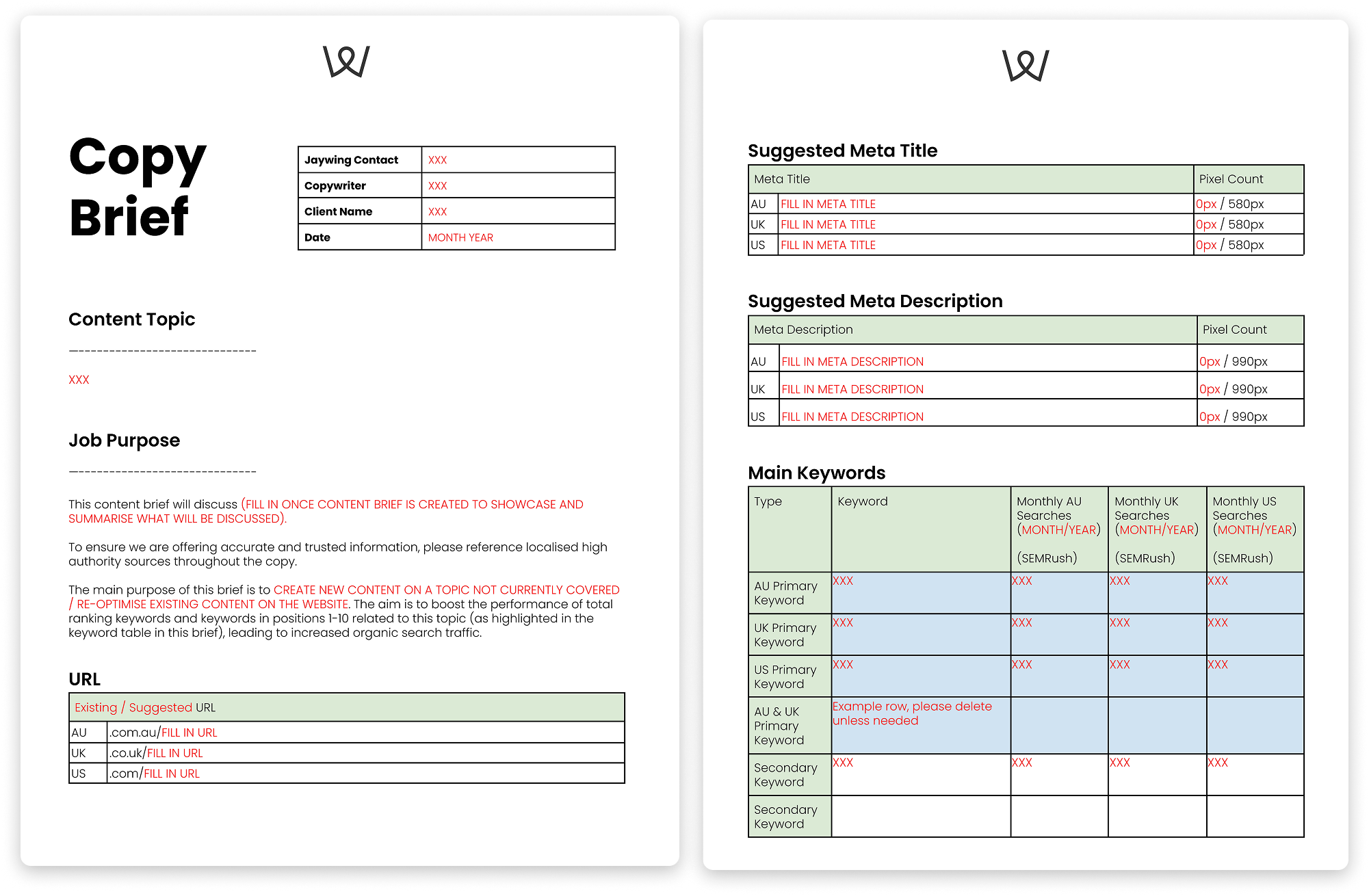
A multi-market content brief guides content creation across several countries or regions. Unlike a single-market brief, it covers all locations in one document and makes clear what stays consistent versus what needs to be localised.
In addition to all single-market fields, the template includes per-market URLs, meta titles, meta descriptions, and keyword data.
Additional fields to populate:
- URLs per Market: Provide a URL for each market (e.g. .com.au / .co.uk / .com).
- Meta Data per Market: Complete separate meta titles and descriptions for each market, each with individual pixel count tracking.
- Keywords per Market: Assign primary keywords per market and include monthly search volumes and current rankings from SEMRush. Shared secondary keywords can be listed once if they apply across all markets.
- Localisation Guidance: Clearly flag what stays consistent across all markets and what must be localised (stats, sources, terminology, regulatory references).
A note on AI tools
We are currently working on how best to utilise different AI platforms and tools to speed up the content brief and copywriting process. More guidance will be added here as our approach is confirmed. In the meantime, refer to the LLM Guidelines for approved ways of working with AI.